We’ve only left the house to eat.
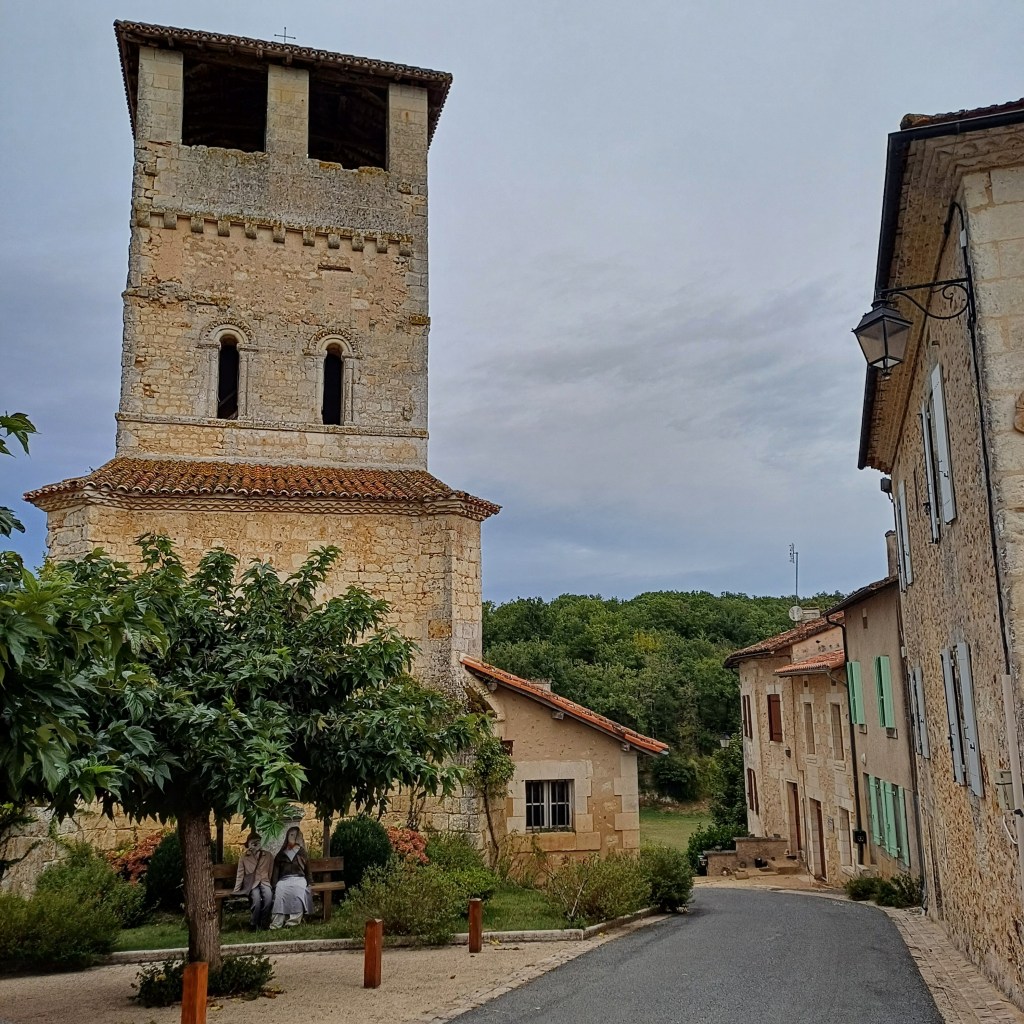
We are in a tiny village. A handful of houses, the prettiest of Maries, and a twelfth-century church. Old stones, salmon pink and pale cream, mottled with grey and brown. Green leaves protrude from minute square windows. I think of them as wide arrow slits. Shutters, beams, towers and porticos.We can see all of this glory from the garden. I peek at it as I’m hanging the washing or playing ball with the dogs and every morning I walk through the valley to reach it. Along a meandering narrow road, flanked by fields of blackened sunflowers, heads hanging, leaves withered on pale lemon stalks. Past the three horses. Past what might have been a small monastery. Past the laverie, water splashing from a series of fountains, icy cold. I let it run over my fingers once and winced.
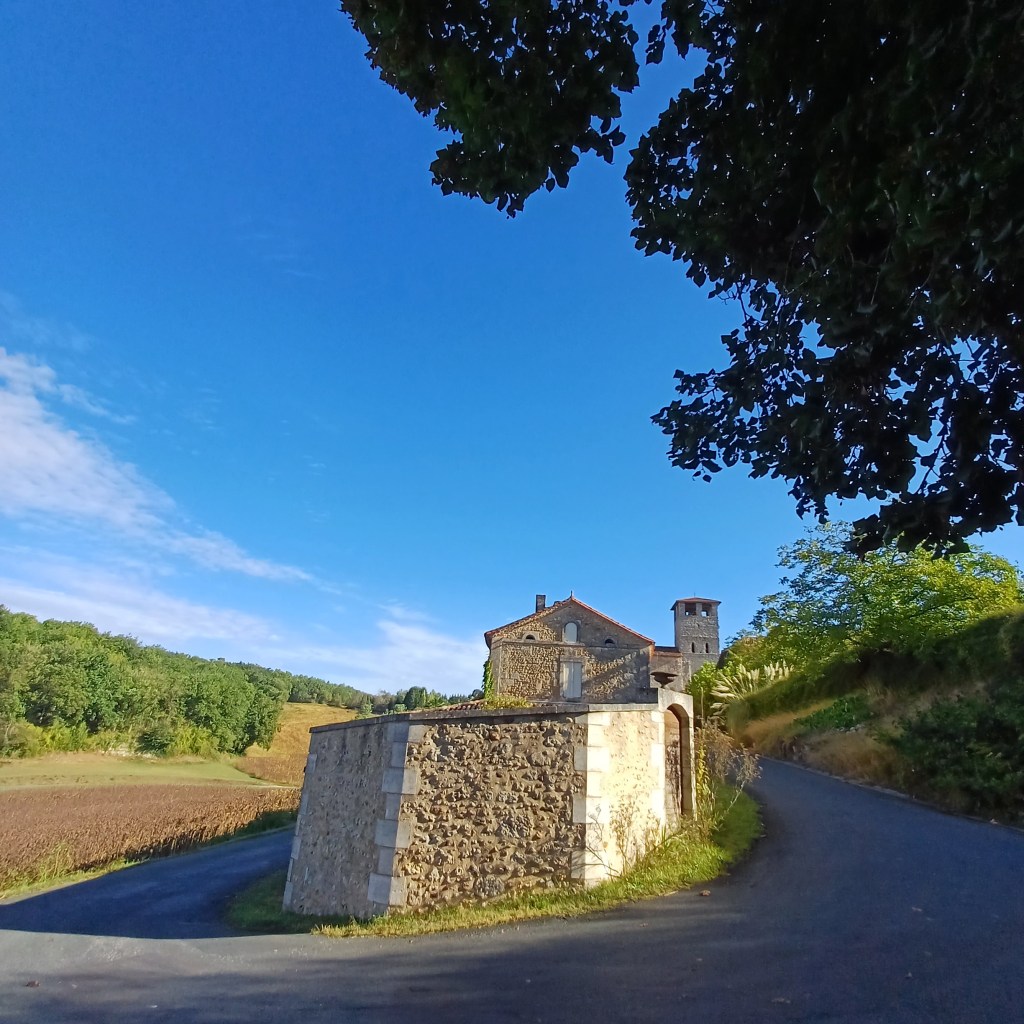

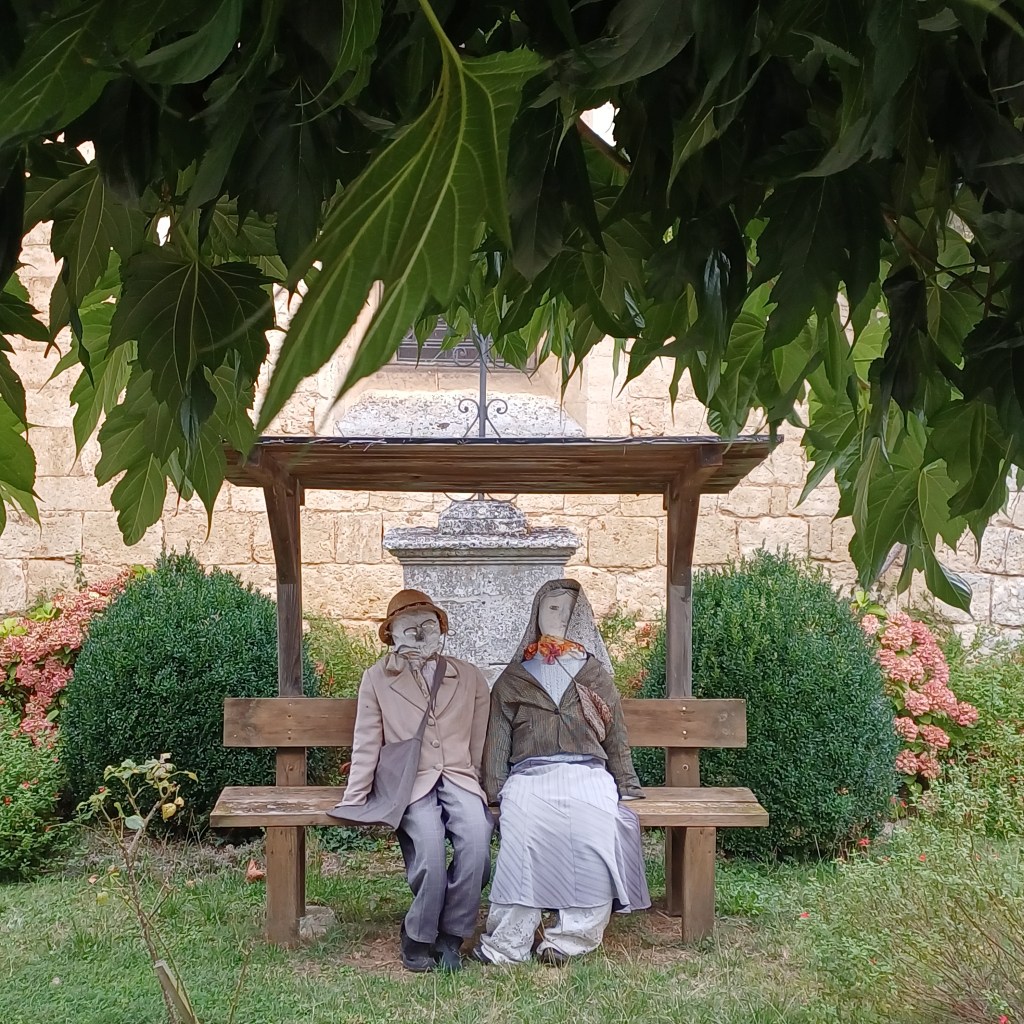
The road curves and winds gently uphill to a teeny triangular square shaded by plane trees where an old couple sit on a bench. They are dolls but I find it very hard not to think of them as real people. Apparently they wore masks during Covid. And then I’m at Le Lavoir. The restaurant our home-owner recommended. I go there for our daily bread and a cafe au lait. In the morning, there’s almost never anyone there. The chef preps the menu. French pop music plays softly. Birds sing and I sit outside and look at the church. It’s a moment of stillness. A quiet moment for myself. A good beginning to the day.
Of course we had to try the menu du jour. I started with pain perdu. A savoury version with chorizo. Followed by a substantial portion of pollock on a bed of creamy polenta. I never cook polenta but was inspired to try. We finished with a brownie – or bruni as the French seem to pronounce it – and a dollop of vanilla ice cream. Lovely. A perfect picture-postcard village and a great restaurant within walking distance. We rolled down the hill to siesta.
Lynda’s first recommendation was so good, we had to try her second. Off to Mussidan we went. Jim called to make a reservation. Perfect French. Until for some reason, right at the end, he had a brain fart and said ‘oui, bonjour’ in closing. He hoped the lady had hung up before she heard him.
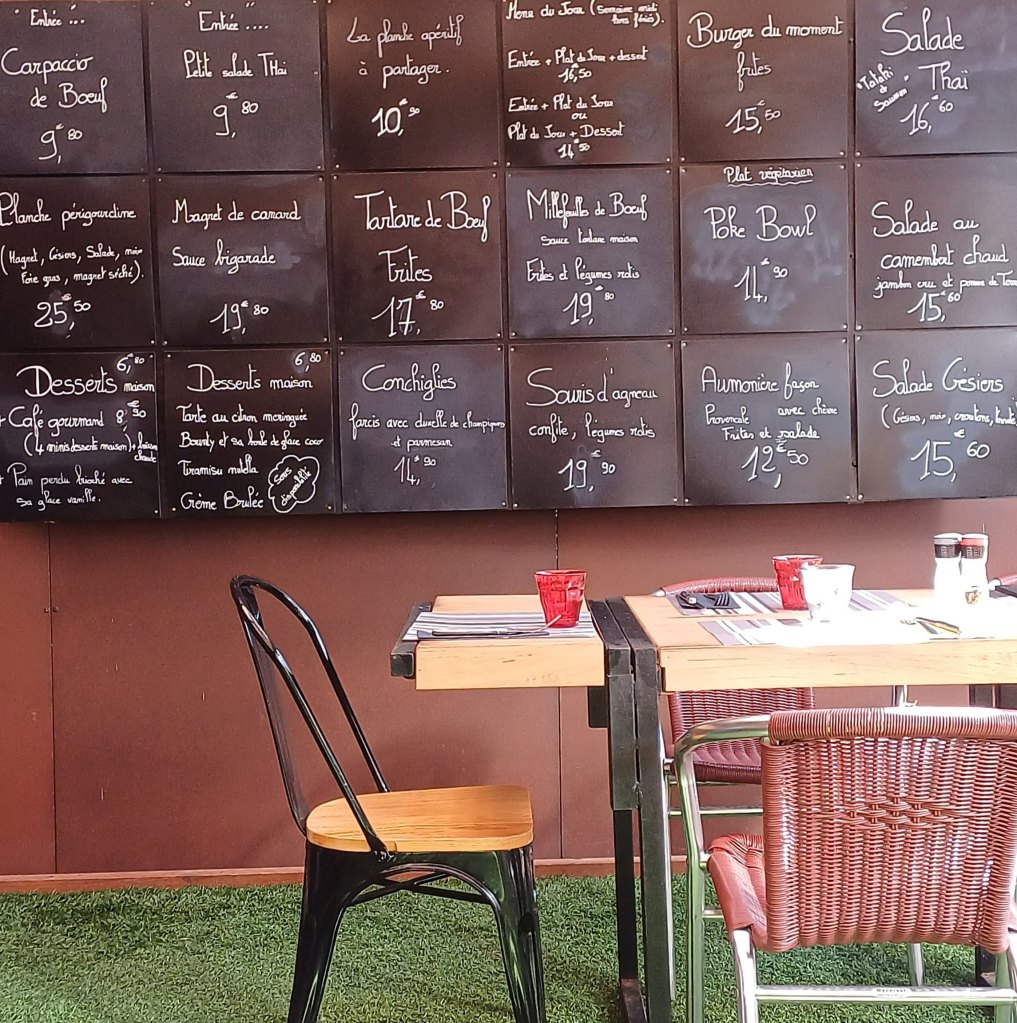
We sat outside on a fake grassy terrace and watched the place fill up. Inside and out. Brains still switched to ‘foreign’ we tried to decipher the extensive menu. Google was not helpful. Conchiglies? Aumoniere? Luckily we worked out that gesiers was gizzards. Phew. But then the waitress arrived and it all became unimportant as we realised none of this referred to the menu du jour. We were having peasant’s salad (thick chewy ham, and cooked potatoes), followed by chicken and chips. Simple, well prepared food, and lots of it. The lady on the table next to us, sucked at the bones, reducing her half chicken to a miniscule pile of scraps. Dessert was the best of all. Jim had his favourite, crème brulée. The top could have been crisper and more caramalised, but it was still good. The lemon meringue was one of the best I’ve ever had. Lemon just sharp enough to make my eyes pop a little and a meringue that cracked like breaking ice.
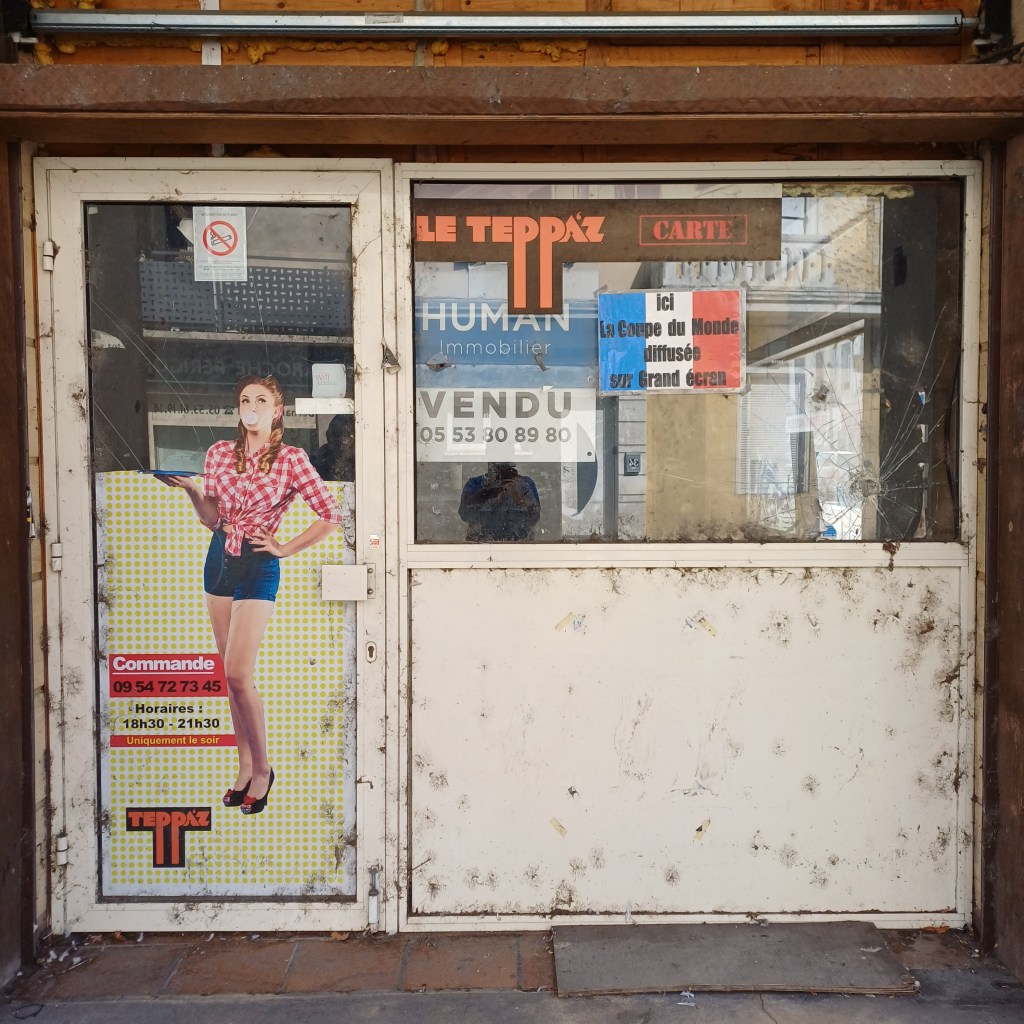
We had just enough energy to drive back to the center of Mussidan and explore a little. But we needn’t have bothered. A home for dead and dying business. Boarded up buildings. Some beautiful but many broken. Shattered panes. Tattered notices. “For sale” signs. Forlorn, forgotten, decrepit and depressing.
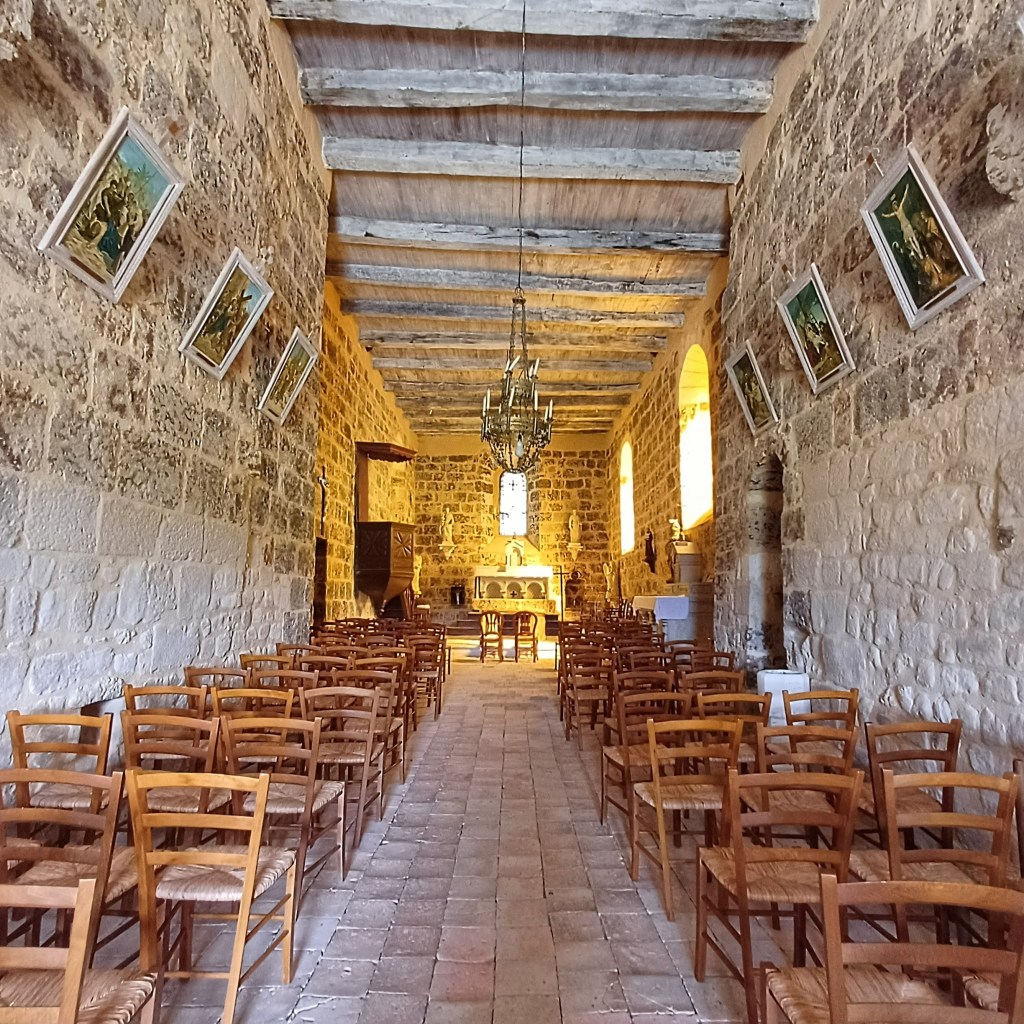
As an antidote we drove home via country lanes, putting ourselves in the hands of the sat nav. Forests and ferns, farms and caramel-coloured cattle. And at Saint Andre-de-Double a quaint, sunshine-filled, yellow-lit church, and a Resistance tale.

We saved the best until last. We were at La Clairiere for three hours and four courses. The cheese board was the star of the show. Three goat cheeses jostled for space with compadres from Normandy and a salty, grainy, thirty-six-month-old Comte. There were soft cheeses, hard cheeses, pale cheeses, an almost bright orange flaky cheese and a cheese with black skin. The lady spoke some English, but the only way she could do the cheese justice was in French. I understood the sentiment completely. The perfect way to end our little exploration of French gastronomy!
Practical Information.
Le Lavoir, Siorac-de Riberac. MdJ Euro 17.50, 3 courses.
Pause & Vous, Bar/Restaurant, 1 rue Raymond Villechanoux, 24400 Mussidan. Opposite the station. Tel: 09 86 45 42 71. MdJ Euro 16.50, 3 courses.
La Clairiere, Servanches. Tel: 05 53 90 69 82. MdJ Euro 30, 4 courses.
 Wondering Woman
Great photos and writing Tracey but what was the resistance story?
Val
LikeLike
It was a fascinating info board about the role of a lady in the village who owned the local cafe and acted as a kind of collector of letters for the resistance. But I just couldn’t make that story fit here!
LikeLike
Sounds like the quintessential French village. Maggie
LikeLike
Evocative as ever Tracey. And I loved the couple on the bench. Weren’t you tempted to give them names? MJ
LikeLike
Never thought of that!
LikeLike
Oh I am drooling, not only for the food but for the whole experience, the setting, the buildings, your wonderful descriptions that pull me in. The whole thing is just lovely! Almost as if I was there. Wish I was!
Alison
LikeLike
I just read ‘On Rue Tatin’ by Susan Loomis. You might like it!
LikeLiked by 1 person
a place of resilient history thanks for sharing!
LikeLike