I asked the magician next door if he tangoed. ‘Not really’ he replied, but he did say there was a practica* a few meters from our front door every Thursday evening. ‘Can anyone go?’, I asked, ‘just to watch?’ ‘Sure’, he nodded. So exactly a week after Marabu, we presented ourselves at the Club General Belgrano at Cochabamba 444. The door was wide open and the General himself stared at us from his green tile surround. Music blared and a lady waved us in, wafted her arm in the direction of the chairs and that was that. No fuss. No payment. Only smiles and acceptance.
We found chairs that didn’t have shoes kicked off under them, or scarves draped over them, or day-packs on top of them. A couple of tables sported wine bottles with reserved notices. Amateur paintings of local scenes vyed for wall space with tango memorabilia, old photos, and dog-eared sheets of paper, proclaiming goodness knows what. There was a fire-place with artificial logs and a mantel bearing a photo of Pugliese and Duke Ellington, in between two silver cups; there were green trailing plants, wall lights and bunting stretching from wall to wall. Overhead fans whirred, at least some did, some hardly moved at all.
The little bar in the corner did a brisk trade. Ice-cold bottles of water, glasses of wine, and empanadas on paper plates covered with napkins flew over the counter. Soda siphons stood on most tables and everyone brought their own mate.
A few couples took to the floor. Some women wore heels but more wore plimsolls and stood on the balls of their feet. Everyone wore everyday clothes. Anything, it seemed, went. Anyone, it seemed, could ask anyone to dance. The stiffness of Marabu was gone. This was a community. People greeted each other as they came in, kissed cheeks, grasped shoulders and laughed a lot. The enjoyment was infectious. I got a rush from watching one couple – he wearing one feathered dangling earing; she with a mass of long curls piled on top of her head. They were mesmerising. So creative, confident, playful and in-tune. They danced like no-one else and I got a tiny inkling of the feeling it must give. A conquest almost; so intimate. At the end of a tanda they collapsed together, smiling, sweating, soaring.
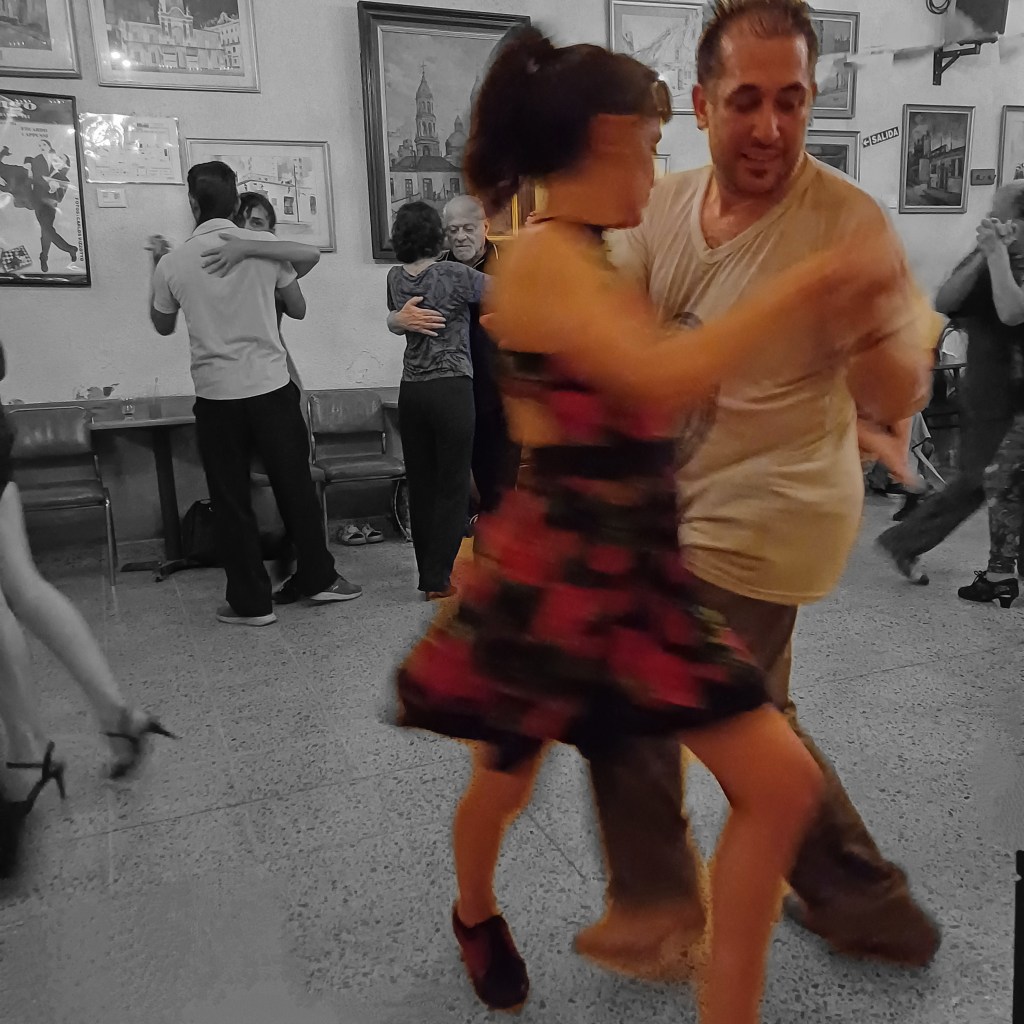
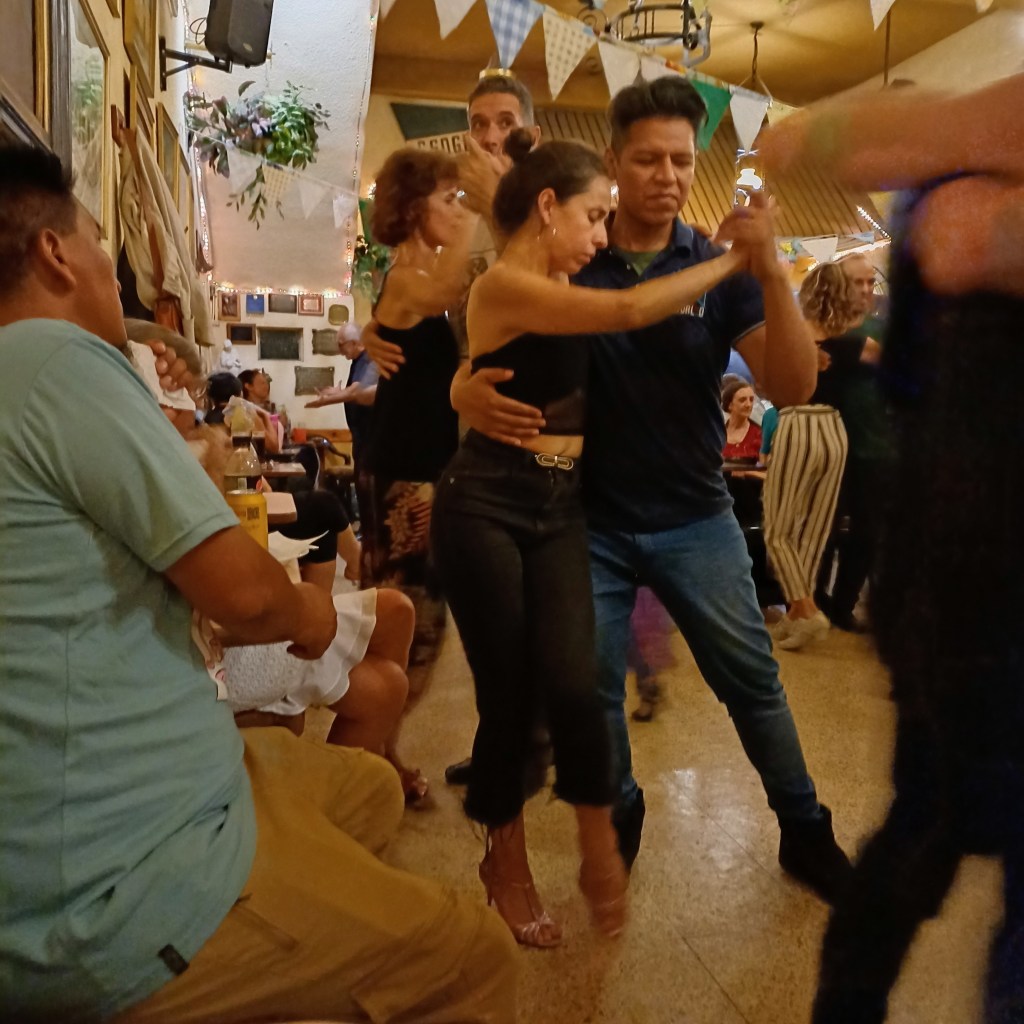
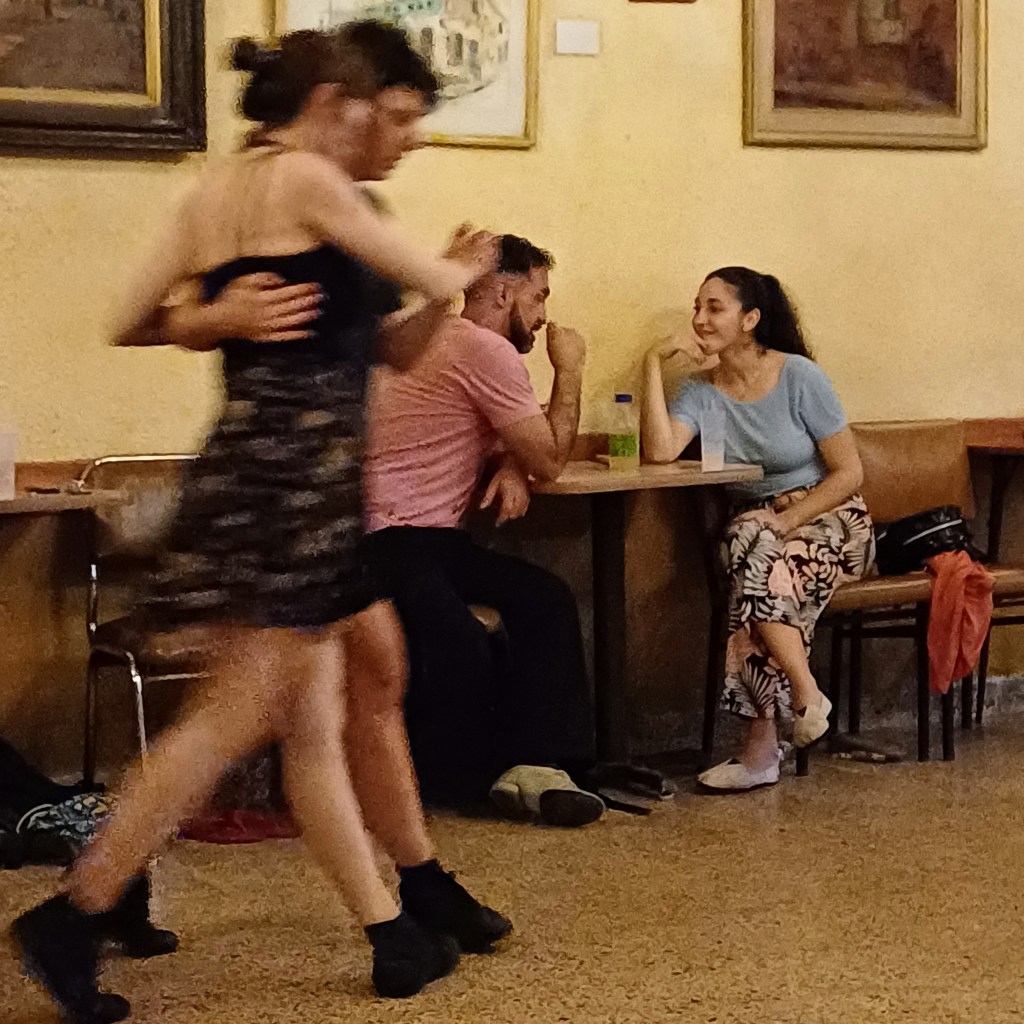
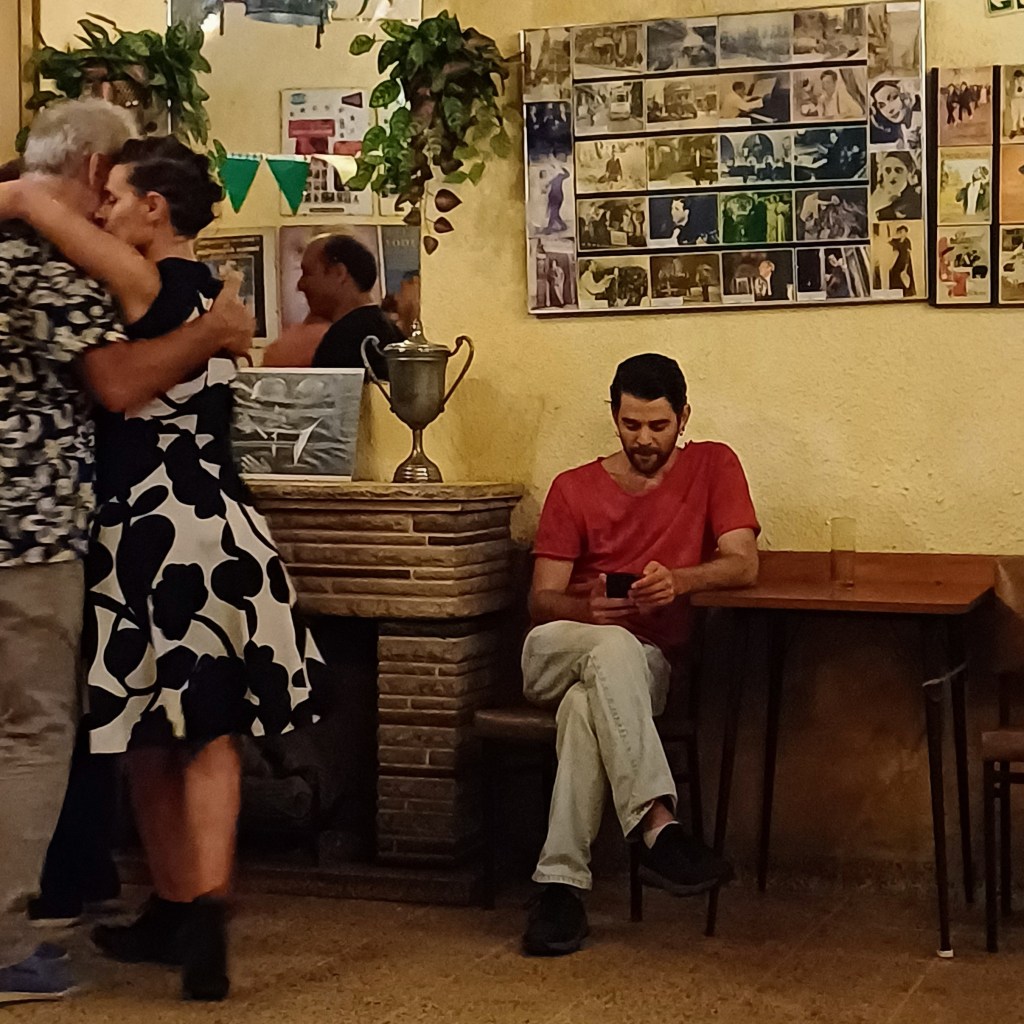
At the start of every new tanda a jolly man walked around with a typed sheet attached to a clipboard – to announce what was playing next. He was part of the furniture in the nicest possible way, attracting cheers and sometimes good-natured jeers. As the floor filled, the heat rose, and bodies dripped with sweat, everyone dabbing at their faces with tissues, pulling their clothes away from their bodies, and fluttering fans. When we left, we filed through a crowd cooling down on the pavement, smoking cigarettes and chilling. Until they tumbled back in and started over. ‘How do you do it – dance until 3 or 4 a.m. and get up for work the next day?’ I asked a young lad one afternoon in a cafe. ‘I don’t know, but we do’, he laughed. Thankfully, we only had to walk 50 m to bed.
On Sundays we went to the open-air milonga on the plaza. Another tip from the magician. After the folk dancing and banging of drums, as daylight disappeared and the green, old-fashioned street lights began to shine, the fairy-lights wrapped around their poles twinkling, couples took to the floor. They danced with backpacks bobbing, and bum-bags bumping, handbags slung over shoulders, in trainers and eco-sandals, young with old, beginners with experts, women with women. No men with men.
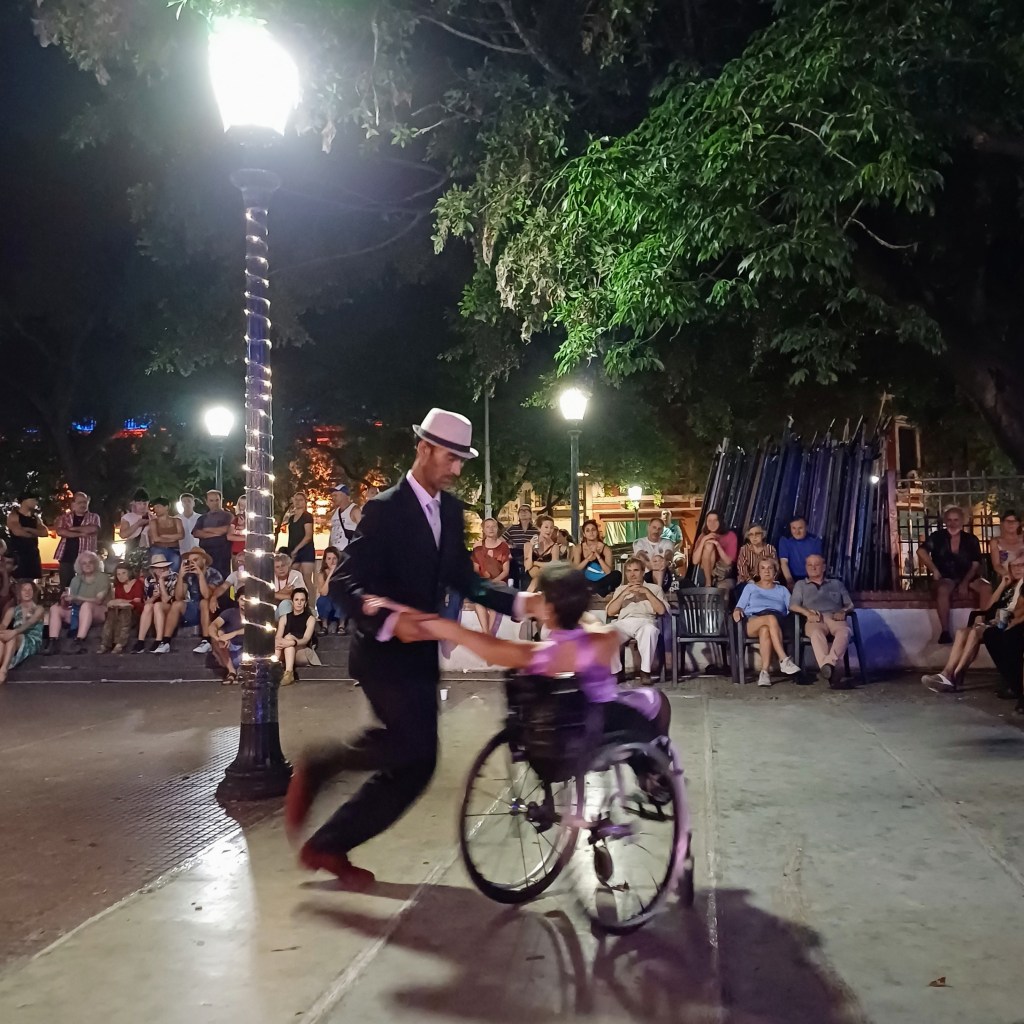

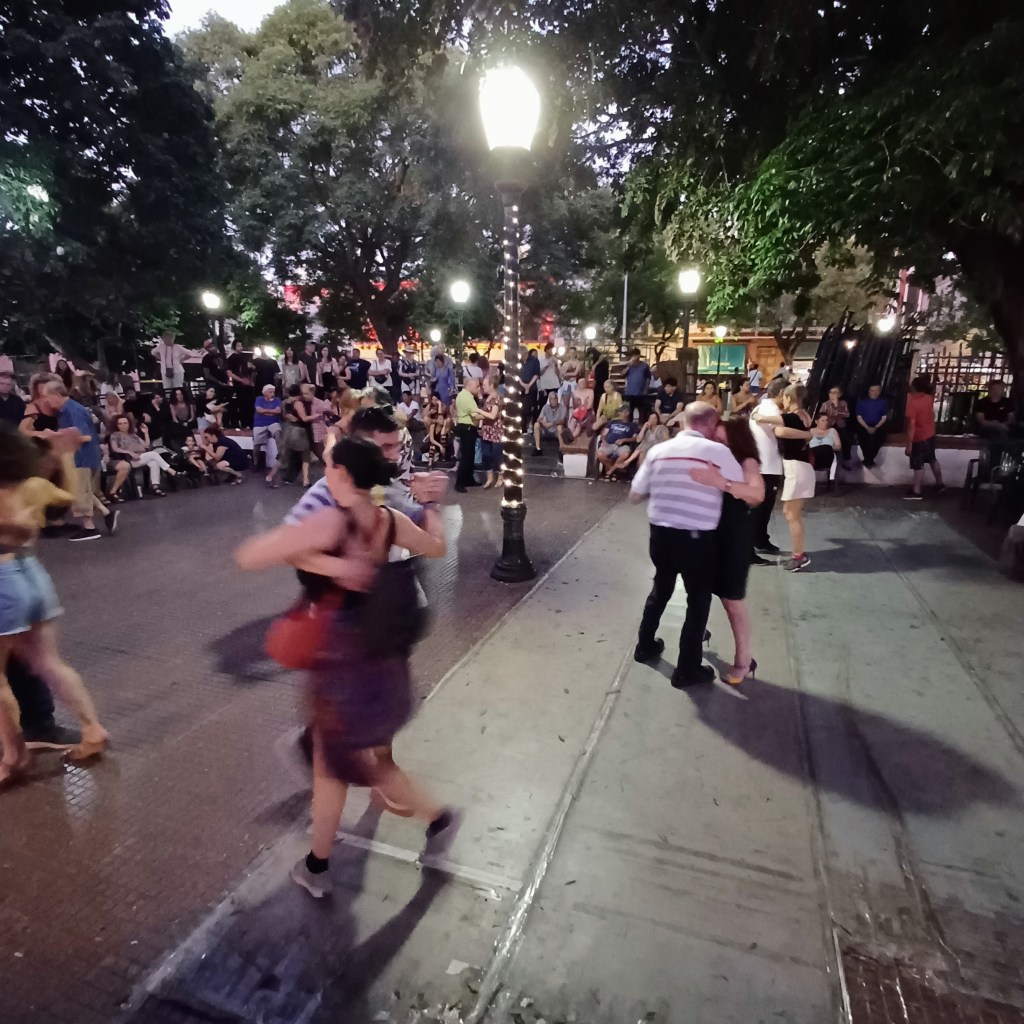

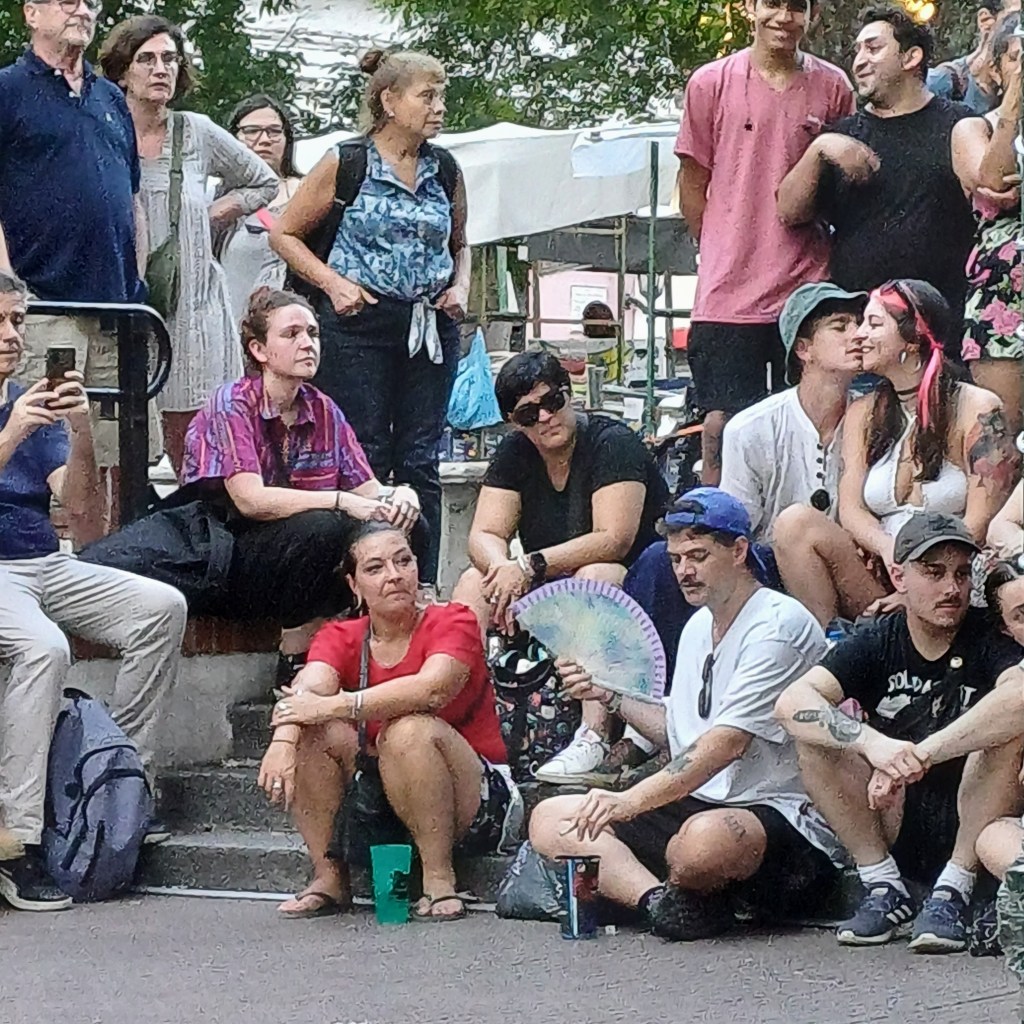
There were no chairs, just steps and a wall to sit on or standing space. A man sold beer and water from a plastic shopping bag. And as workmen dismantled the Sunday market stalls, boards and metal were thrown to the ground with a crack and a clatter.
We began to recognise locals who turned up every week. The neatly-dressed old man, who specialised in asking young tourists to dance and seemed intent on giving them a lesson. The splendiferous old couple – he with stetson and she with a short dress, sparkles, heels, jaunty hat, and a bandaged leg. They had their own dance entirely, a ghost of a tango. At the end of every tanda she acknowledged her public with a bow, as if the event was her’s alone. I admired her verve. Occasionally the wheelchair couple from Plaza de Mayo were there. Once they did a guest spot, a heart-still-stand moment; when he lifted her entirely out of her chair and whirled and waltzed with her, before setting her gently back down.
The diversity of the dance is mind-blowing. We began to feel there were two tangos. One ‘old-school’, traditional, full of sex and intrigue, the other, a pure love of, and joy in dance. A straight-forward connection and communication. Jim told me that sometimes he almost has a transcendental moment, watching all those twirling, swirling bodies, that he feels the harmony of the universe. It’s infectious happiness.
Tango really is a drug.
* practica – is for practicing, a milonga is for social dancing.
Practical Stuff.
Practica. Club General Belgrano, Cochabamba 444, San Telmo. Thursdays 22.00-02.00. ‘A la gorra’: Donation gratefully received. Very local.
Milonga Placita del Panuelo Blanco. Plaza Dorrego, San Telmo. Sundays 20.00-23.00. Doesn’t happen if it rains. ‘A la gorra’: Donation gratefully received.
 Wondering Woman
I hope we’re going to get a demonstration!
LikeLike
Don’t hold your breath!
LikeLike
I’ve been Tangoed……captivating. It sounds mesmerizing and special. Love the photos. Thanks Tracey.
LikeLiked by 1 person
Should’ve used that as the title!
LikeLike
I would sprain my ankle wearing those shoes. Still learning to dance 😉 Tango dancing is magic to watch.
LikeLike
I wouldn’t be able to walk wearing those shoes!
LikeLiked by 1 person
Oh so wonderful. Thank you for reminding me of one of the reasons I loved BA so much – people dance! Milongas everywhere, afternoon, evening, in the halls, in the squares. What a beautiful thing it says about the culture. I think the splendiferous old couple is the same one I saw dance at the San Telmo Feria 9 years ago!
Alison
LikeLike
That’s what I loved too! Amazing that people really do dance in the streets. It’s a city of music and creativity, so alive! I would not be at all surprised if it was the same couple – a living example of what all the dancing can do for you!
LikeLiked by 1 person
thanks for sharing, there is something very unique and special about the tango!
LikeLike
And difficult! They make it look so easy!
LikeLike