We’ve just set off on our first far-away adventure since Covid struck. Rather perversely my thoughts turn to our last big trip, to Vietnam. I somehow didn’t have the heart write about it then. Now I do. So while I gather my thoughts about Madrid, and as we move on to Buenos Aries, I look back on Hanoi with so many good memories. I cannot say that the information in the practical stuff still holds. But I leave it there – just in case.
Hue, Vietnam, February 2020.
‘Vietnam country very beautiful. Very sad too’. Mr Thinh.
‘You come with me’, Mr Thinh said as he strapped on my helmet. Jim followed behind with Mr Da. No more words, just wind in my face, and discomfort. My mind focused only on the discomfort. We had a long way to go and already I wanted to get off. After a half hour that lasted forever, we stopped. ‘Otherwise it’s too much’, said Mr Thinh. ‘Breathe and smile’ is his mantra.
At the edge of Highway 1 we sat under the trees and sipped on hot lemon juice. Mr Thinh has lived in Hue all his life. ‘Much fighting in my city’, he told us. His uncle was killed at the age of nineteen in a napalm attack on the university. Four years later, his father died in a B52 bomb blast. ‘We wanted to find his body, to bury him. It’s very important for Buddhists. But it wasn’t possible’. Mr Tinh has no brothers and sisters – ‘my family is very small’ he told us sadly. He lives with his mum – who at 91 is a bit forgetful, and has aching knees in bad weather, but still does Tai Chi every morning – and his wife and 12 year old daughter. He talked about his children and his two and a half year old grandson and the love shone from his face.

‘I went to the pagoda after my father died. I wanted to pray to help him get to heaven’. Eleven years of study of Buddhism followed. ‘I love my work, and I especially love doing tours of the DMZ’, Mr Thinh told me. ‘I love history so much’. He wanted to know why, he said – why all the killing, to try and understand what had happened in his country and why so many had died.

The DMZ is a 5km long strip of land on either side of the Ben Hai River. From 1954- 1975 it acted as a buffer between the North and the South – supposedly a non-military zone, the DMZ became one of the most militarised areas in the world, forming what Time magazine called ‘a running sore’.
Our first stop was Vinh Linh Cemetery. A sobering sight. Row upon row of white headstones. Each momentarily with a pop of colour – a single yellow marigold in a blue ceramic vase; the government remembers the fallen twice a year, at TET and again in December. Mr Thinh said, ‘So many. So young’. This was no academic approach to the rights and wrongs of the Vietnamese/American War, but a purely visceral, emotional, gut wrenching reminder that there are no winners in such a situation. Many of the graves are empty, and bear names only to represent a fraction of the 300,000 Vietnamese soldiers that went missing in action. From the cemetery, we walked to cracked and overgrown bunkers where American GI’s lost their lives. ‘I pray for these people. I think some souls are trapped here, unable to return home’, Mr Tinh told us. A little while later, another stop at the side of the highway, and we were looking at a rusted American tank. ‘Eleven Americans died here’.
Back on the bike to the Ben Hai River Bridge, one half painted blue to denote North Vietnam, the other yellow for the South. An atmospheric spot. A reunification monument on the Southern bank, depicting a mother and child, symbolic of families that were split during the division of the country and war.
But at Vinh Moc families fought to stay together. Down, down, down we went into a system of tunnels built secretly between 1966-1967. Three different levels were dug under cover of night – 12, 15 and 23 metres deep, with 13 entrances and exits including 7 to the coast. This provided ventilation and all important supply lines to the sea. The Americans knew the tunnels were there – and believed they were used to move supplies to the North – they just didn’t know their exact location; and so in 3 years, 7 tombs of bombs were dropped for every person living in the tunnels.
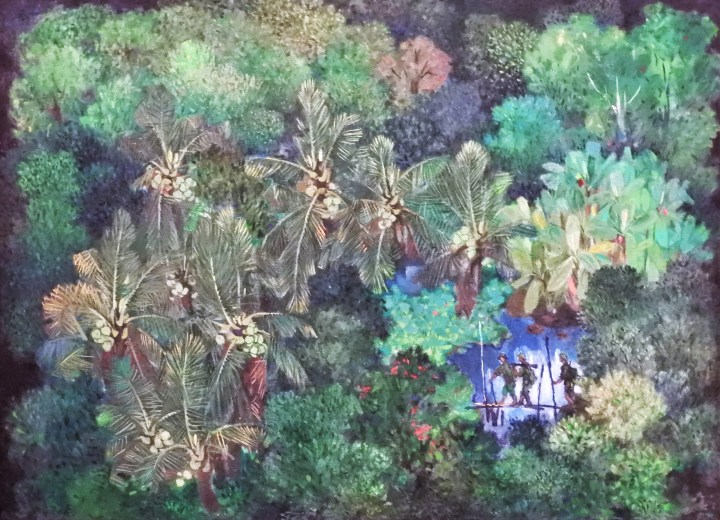
When the alarm was sounded for an imminent bombing, villagers went underground and stayed there for as long as necessary. The longest continuous stretch was for five days and nights. The tunnels were low and narrow, we needed to stoop. ‘Oh to be short’, moaned Jim. It was dark and damp and constricting. I longed to be outside. And then it dawned on me – three hundred people found shelter here for six years. Life carried on underground. Nooks to sleep in, a meeting room, a kitchen built with a system to release yet hide the smoke. There was an operation room, a nursery, a maternity ward – seventeen babies were born in the tunnels. ‘Some of them come back to visit from time to time’, Mr Thinh told us. It was staggering on so many levels. We popped out by the ocean, and I was glad for open space and fresh air. ‘Amazing’, Jim mumbled.
‘
There were very big fightings. Big history happened up here. Now you understand something of the Vietnamese people. They win because they love so much to be in peace’. Mr Thinh.
Practical Stuff.
We went to the DMZ with Tran van Thinh Tours http://www.tranvanthinhtours.com (from Hue). If you want facts and figures this tour might not be for you. If you want a personal and thought provoking account, sign up for Mr Thinh’s tour.
For a short, but lovely film about Mr Thinh see http://www.tranvanthinhtours.com/movie
DMZ Tours are also possible from Dong Hoi and Phong Na.
Note on the Vinh Moc tunnels – the tunnels are cramped – 1.6 metres high and 1.2 metres wide – bigger than the Cu Chi Tunnels, but most people will have to stoop. Possible to visit without a guide – if you do this, take a torch. Some of the tunnels are unlit.
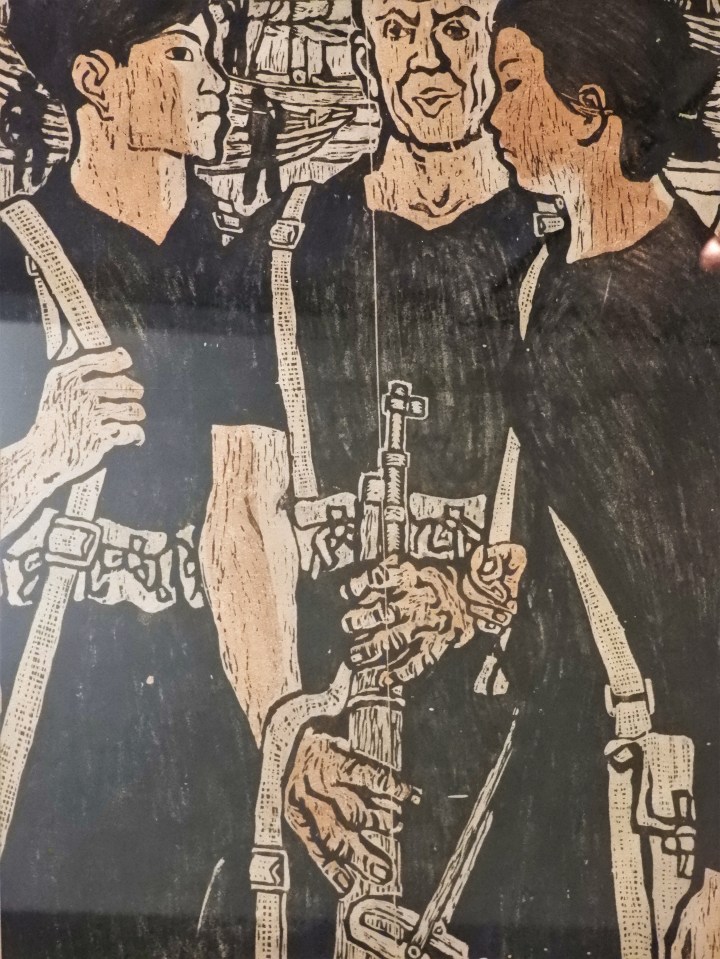
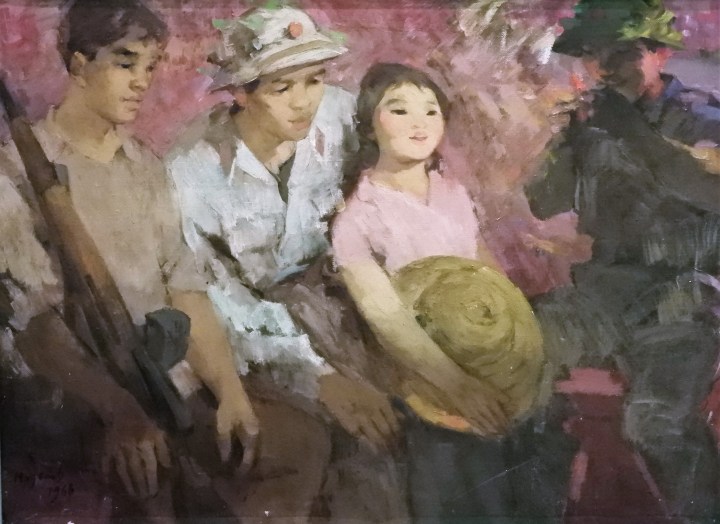
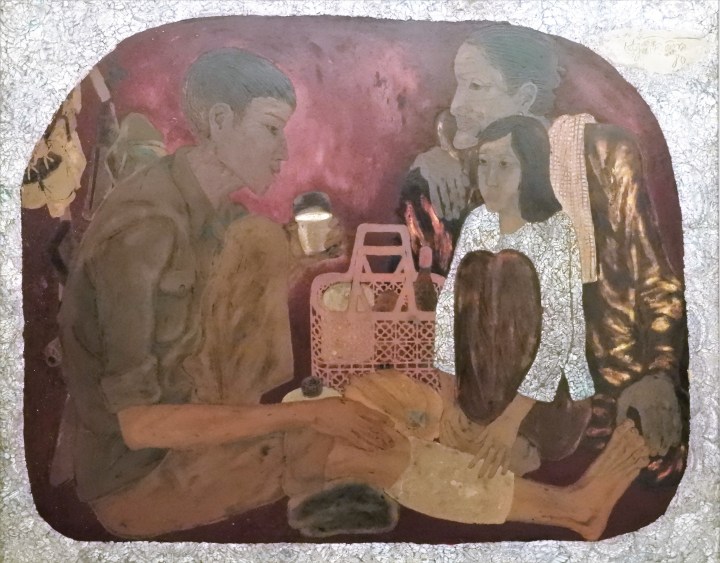
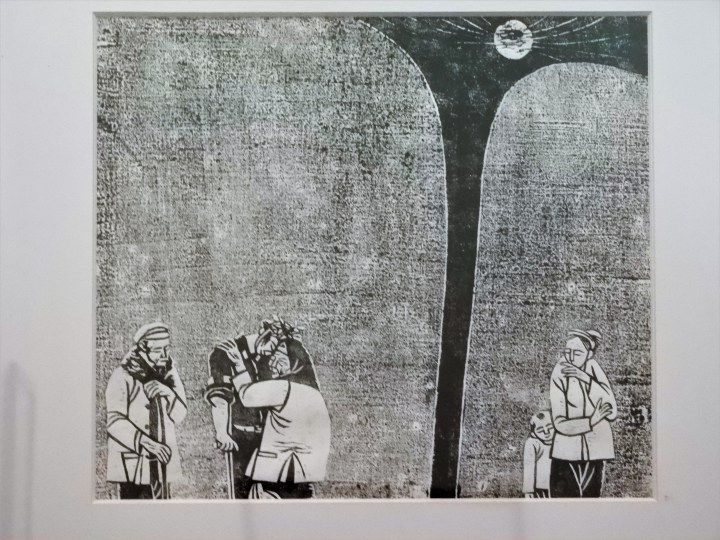
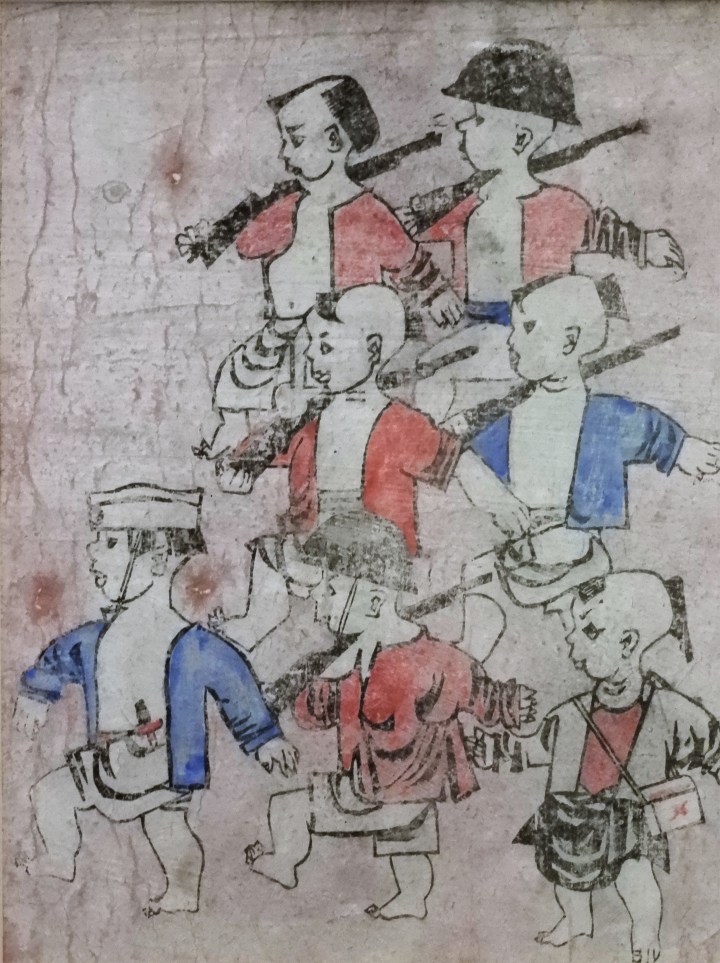
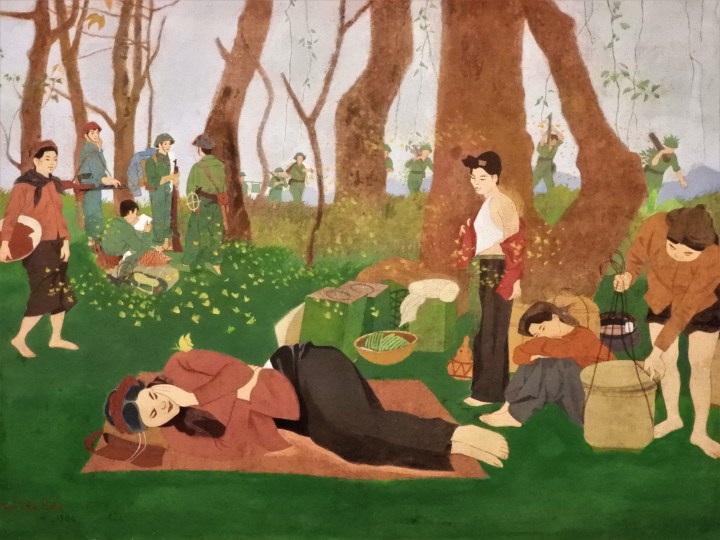
The photographs in this post are all paintings to be found in the Fine Arts Museum of Vietnam in Hanoi.
 Wondering Woman
Moving blog Trace. 🌈❤️
LikeLike
Hi Tracey. What a powerful piece of writing. Really well done and very moving.
MJ
LikeLike
Thanks Sue. It was quite something re-living Vietnam.
LikeLike
Thanks MJ. He was quite something, Mr Thinh.
LikeLike
Yes, very thoughtful. I would go with Mr Thinh’s tour. My sister in law, spent many a night during her childhood waiting in line for some food to take home. One night she fell asleep and they had no food. She was 9 years old.
LikeLike
Heartbreaking. Sometimes we don’t realise how lucky we are.
LikeLiked by 1 person
That is true, depending on who we are comparing ourselves to.
LikeLike
what an incredible experience – thanks for sharing
LikeLike
Thanks for reading!
LikeLike
Oh this broke my heart about the American invasion of Vietnam all over again. Back in the 70’s in Australia I protested the war. It was so unnecessary. And cruel. As are all wars. Endlessly old men create wars for young men to die in 😢
I’d like to go back to Vietnam and do this tour.
Alison
LikeLike